How Process Analysis Can Improve the Outpatient Experience
Learn how rapid process analysis helps healthcare organizations identify patient flow bottlenecks, prioritize improvements, and create a clear path to better experiences and throughput.
Seeing the Clinic Through the Patient’s Eyes
Columbia Orthopedics is a patient-focused outpatient orthopedic practice known for advanced musculoskeletal care and a strong commitment to personalized treatment. Like many busy clinical environments, the practice was already functioning at a high level. Patients were being seen, staff were engaged, and providers were delivering specialized care across a wide range of orthopedic needs.
But the administrative team also recognized an opportunity. They wanted to improve the patient experience by reducing wait times, clarifying patient flow, and better understanding where friction occurred throughout the visit. They understood the value of process improvement, but they needed help identifying where to begin and which changes would create the greatest impact.
Array saw an opportunity to bring a fresh, unbiased perspective to the clinic’s daily operations. Rather than begin with assumptions or predefined solutions, our team conducted a swift, targeted process analysis designed to reveal how patients, providers, and staff actually moved through the clinic.
A Focused Look at Patient Flow
The assessment was intentionally brief, but rigorous. Over the course of a focused workshop and observation period, Array’s healthcare architects and systems engineers studied the clinic from multiple perspectives. The goal was not to disrupt operations or conduct a months-long study. Instead, the team sought to quickly identify the most visible barriers to flow and translate those findings into practical next steps.
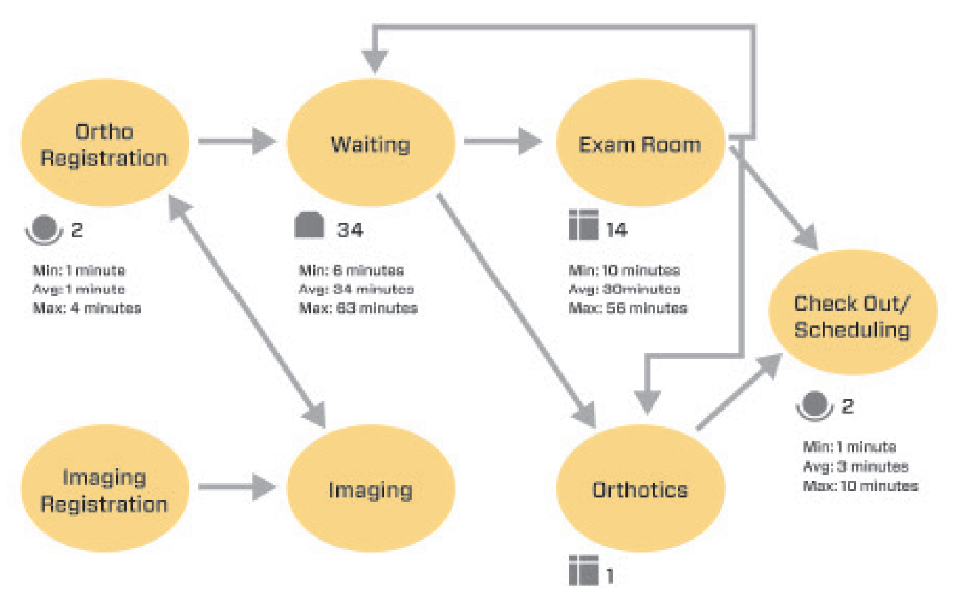
The process began with a general overview of the patient journey, from arrival to departure. Staff walked the team through the expected sequence of activities, helping establish a baseline understanding of how the clinic was intended to operate.
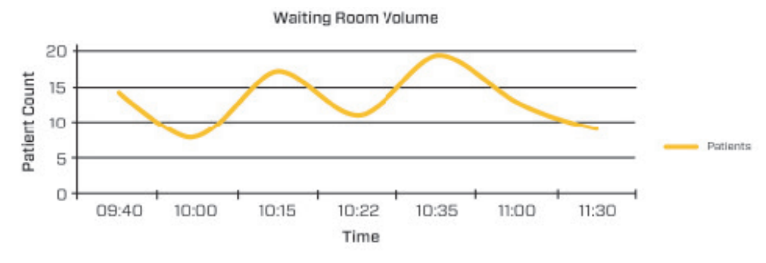
From there, the team observed the process in real time. Patient flow was studied from the perspective of patients, physicians, and medical assistants. Using spaghetti diagrams, the team tracked movement throughout the clinic to understand how people traveled between spaces. Time-study sheets captured key moments in the visit, including length of stay and physician interaction time.
In addition to direct observation, Array conducted brief interviews with staff at multiple levels of the organization. These conversations helped reveal the daily workarounds, recurring issues, and patient concerns that are not always visible on a floor plan or process map.
What Observation Revealed
Even in a well-run clinic, small points of friction can accumulate. During the observation period, several common themes emerged.
At times, patients who were not accompanied by staff were unsure where to go next. This uncertainty affected the patient experience and created opportunities for delays or additional staff intervention.
The team also observed that clearly separated staffing roles could create uneven workloads. Some team members experienced downtime while others carried a disproportionate burden, depending on the moment and the needs of the clinic.
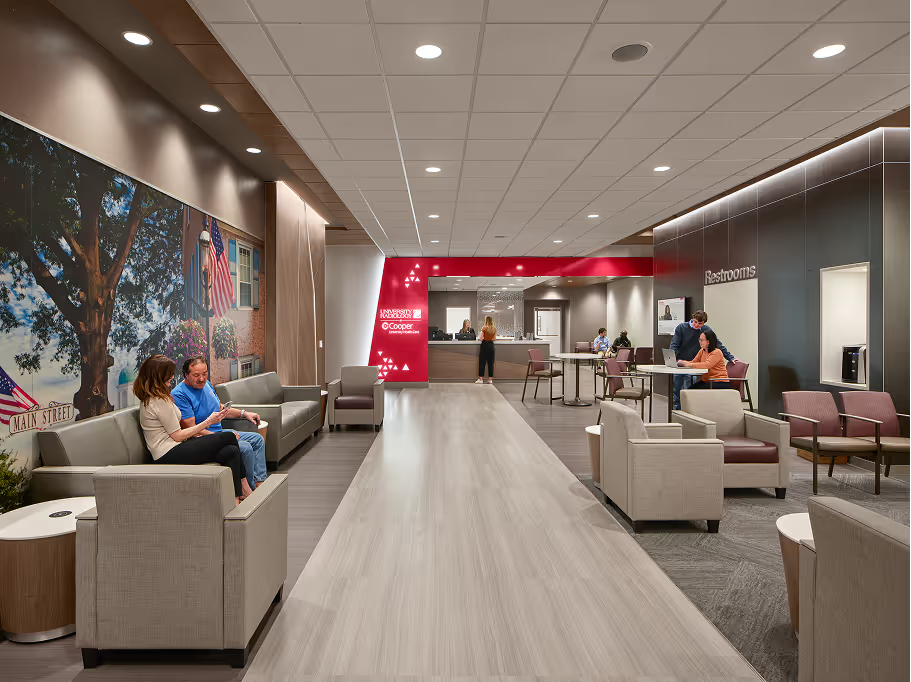
Physical space also played a role. Patients with limited mobility had difficulty navigating certain waiting areas where space was constrained. In an orthopedic environment, where many patients may use mobility aids or move more slowly, these spatial limitations can have an outsized impact on comfort and flow.
The team also noted moments when staff were forced to “fight fires” caused by breaking points in the system. These moments are common in healthcare settings. They often reflect staff dedication and adaptability, but they can also indicate that the process itself needs additional support.
Together, these observations helped Array understand not only where delays occurred, but why they occurred.
Listening to the People Closest to the Work
Front-line staff often provide the clearest view of how a process truly functions. They see where patients get confused, where communication breaks down, and where workarounds have become part of the daily routine.
Array’s interviews focused on practical questions:
- What are the most pressing complaints from patients regarding their clinical experience?
- What major issues do you encounter each day?
- If you could change one thing about how the clinic operates, what would it be?
These conversations helped connect observed conditions with lived experience. They also provided important context for distinguishing between isolated issues and recurring patterns.
Because staff are deeply familiar with their own environment, it can be difficult for them to step back and see non-value-added steps. That is where an outside perspective can be useful. By pairing staff insight with process improvement tools, Array was able to identify opportunities that were both grounded in daily operations and informed by broader healthcare planning expertise.
Translating Findings Into Action
The process analysis produced a targeted improvement plan that identified specific opportunities to improve patient flow, reduce waiting, and strengthen the patient experience. The recommendations addressed several areas, including scope, staffing model, communication, interdepartmental orders, the physical environment, and staff interactions.
Rather than deliver a generic improvement strategy, Array provided Columbia Orthopedics with a customized plan based on direct observation and staff input. The assessment helped define where further investigation would be most valuable and gave the client a clearer path for selecting improvement projects that aligned with their current needs and resources.
The work also helped establish a foundation for future planning. By understanding the current state of operations, the organization could begin to define its ideal future state and determine whether improvements should focus on workflow, staffing, communication, physical design, or a combination of these factors.
Why Process Comes Before Design
In healthcare environments, design decisions are most effective when they are grounded in a clear understanding of operations. Before exploring physical solutions, it is essential to understand how work flows through the system, where value is added, and where unnecessary steps create waste.
Process mapping, observation, staff interviews, visioning, and spaghetti diagrams all help make invisible challenges visible. These tools allow teams to see how people move, where time is lost, and where the built environment supports or constrains care delivery.
For Columbia Orthopedics, the assessment showed how a short, focused process analysis could uncover meaningful opportunities for improvement. The clinic was already strong. The goal was to help it move from good to outstanding by identifying practical changes that could improve the experience for patients, providers, and staff.
As Laura Moran, Healthcare Systems Engineer, noted: “Sometimes it takes unbiased eyes to see the potential for improvement.”
Moving Toward a Better Future State
At the conclusion of the assessment, Array provided recommendations for further investigation and implementation. These options allowed the client to choose the services that best matched their strategic goals, operational priorities, and available resources.
Potential next steps included a more detailed process analysis, future-state process design, and a comprehensive transformation plan. Each would build on the initial findings and help the organization move toward a more efficient, patient-centered model of care.
For outpatient practices, the lesson is clear: improving flow does not always begin with a major renovation or sweeping operational overhaul. Sometimes, the most valuable first step is simply slowing down long enough to observe what is happening, listen to the people closest to the work, and identify where targeted changes can make the greatest difference.
Through a Lean-led approach to project definition, Array helps healthcare organizations clarify their goals, understand their processes, and define the right project before design begins.