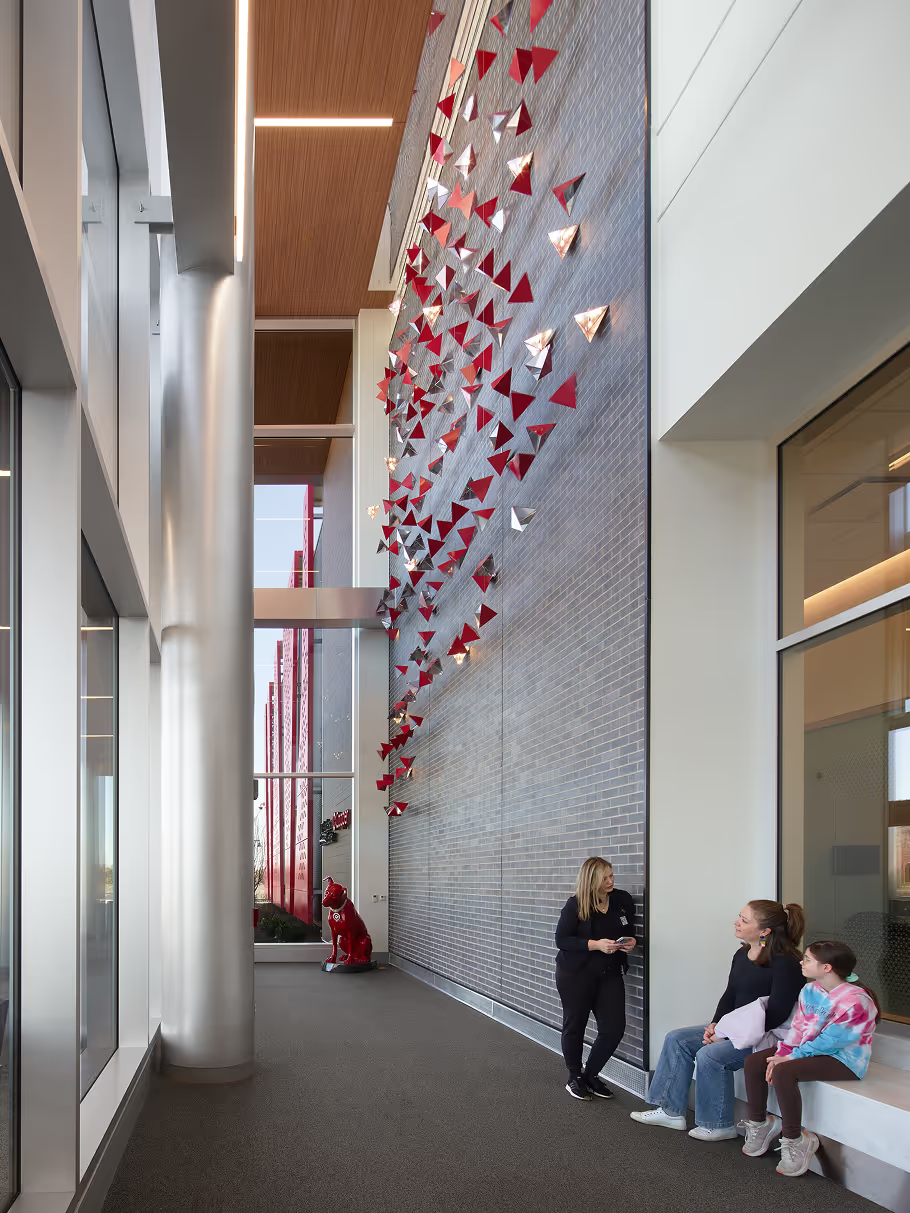
Childrens National Medical Center
Learn how predictive analytics and simulation modeling help healthcare leaders reduce emergency department bottlenecks, optimize staffing, and improve patient flow with confidence.
Modeling patient arrivals can ensure appropriate resource utilization and maximize patient flow. Understanding the unique factors that each facility faces should drive solutions rather than national benchmarks or averages. Using predictive analytics and simulation modeling, we help each client develop the best solution for their situation.
CHALLENGE
An urban academic medical center focused on pediatrics sees more than 85,000 visits each year in their emergency department. Designed 15 years ago, the segregated pods and small triage area limit flexibility and result in long lines and unsafe conditions.
SOLUTION
Resource Utilization
Through process mapping and discrete event simulation, a multidisciplinary team was able to test ultimate patient flow approaches to identify the optimal balance of process time and staffing resources to ensure consistent success.
EXECUTIVE SUMMARY
Before facilities consider architectural solutions, we help them design the process. In this case, lean improvement work had been underway in the emergency department. The group reached a threshold they believed needed to be overcome using an integrated process and space configuration solution.
When appropriate, we employ simulation modeling and predictive analytics to help clients make important early-design decisions with clarity and certainty. Rapid testing and data-driven decisions guide our work. We were able to leverage existing throughput data to rapidly build a simulation model.
The model incorporated existing patient census data, which was quickly enhanced by the expertise of the nurses and doctors in the room. As we built the simulation model, we continued a dialogue with the emergency department staff to ensure that the output was matching reality.
Using the simulation model, our cross-functional team of engineers, nurses, doctors and other support staff was able to test a number of different patient flow options. As we experimented with different solutions, everyone in the room could see the impact of adding an additional security desk staff or removing a triage room. This hands-on approach helped the group quickly arrive at the optimal solution, which balanced patient waiting times and staff utilization, and ensured each provider was working at the top of their licensure.
CLIENT PROFILE
Children's National Medical Center Washington, DC
As the only health system designed for kids in the Washington, DC, metropolitan area, CNMC believes every child should be cared for by professionals who have devoted their career to children's medicine. At Children's National Health System, they are dedicated to providing the best pediatric care for their patients, families and community. They are the premier provider of pediatric care in the region and the only freestanding children's hospital between Philadelphia and Atlanta.
Serving the nation's children for more than 140 years, Children's National is a proven leader in the development and application of innovative new treatments for childhood illness and injury.
TOOL
Resource Utilization
A resource is anything that aids the movement of work through a system. Organizations hope to optimize their resources' utilization because they typically have an associated cost, which decreases with higher utilization. After determining ways to maximize throughput and implement flow, we can ensure full resource utilization without creating non-value-adding process steps.
Current Conditions
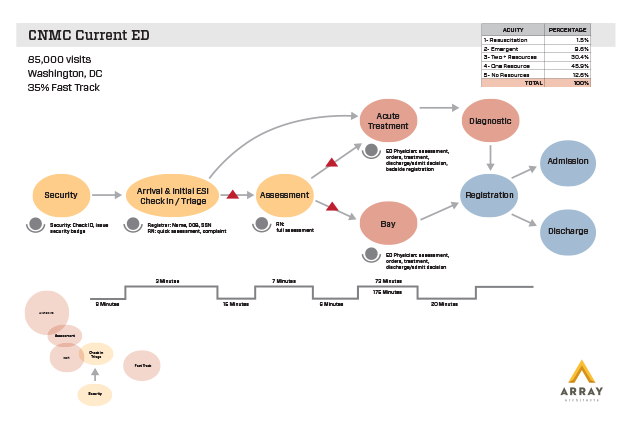
Time was of the essence. Check-in lines were long and creating unsafe supervision conditions in the waiting room. Door-to-Doctor times were longer than acceptable for some patients. Length of stay was much longer than national markers. Patients and their families were waiting at every step in the process.
The care of emergent pediatric patients is complex. Rapid decompression and non-specific symptoms make any unsupervised wait dangerous. In an effort to gain as much information as possible, a two-step triage and assessment process was in place. Protocols could be started early and providers knew that patients were evaluated in detail, even if they had a long wait. The unintended consequence was a bottleneck at assessment.
To combat the problem, the providers felt a redesign of the arrival area, in conjunction with combining some existing care steps to reduce patient moves, was necessary. While this seemed like sound logic, we were concerned the root cause of the problem might be deeper. Together, we conducted an eight-week, process-led design study to understand the current condition and develop a sustainable future state model.
Data
Using data the internal group already collected, we developed a simulation model to test the implication of process decisions on overall throughput and resource needs. We created a dynamic tool that allowed the team to change the variables during our future state design meeting. This real-time feedback allowed quick consensus and decision making about the ideal future state.
It became apparent through simulation that combining triage and assessment would slow down the system further and require a high number of triage nurses to handle peak volumes. The providers felt it wasn't the best use of so many highly-trained pediatric emergency nurses to be tied up in triage.
Focusing then on reducing overall length of stay (while still attempting to reduce patient moves), the group instead moved assessment to the bedside and reduced the initial contact to reflect a more conventional triage. This allowed them to quickly iterate and evaluate the large volume of patients they see each day with wait times of less than five minutes for 99.62% for all patients.
Future State
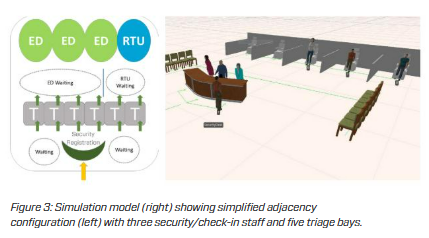
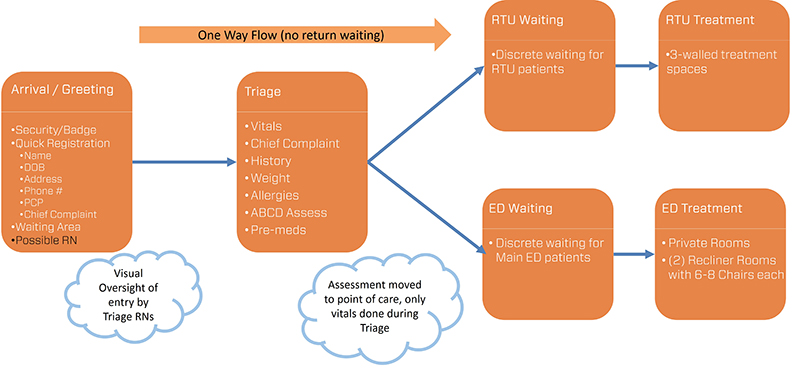
By redesigning the process of security, registration and check-in, and shifting the nursing assessment to the bedside, patient throughput could improve by focusing on the key information at each step. Through simulation, we determined that adding one additional registrar reduced overall wait times and allowed two nurses to return to bedside care within the current staffing model.
Shifting to a more traditional triage approach left some providers concerned about wasting room overnight. Through continued process-led design, we developed a one-way flow model that moves patients to sorted waiting areas that can be overseen by clinical staff immediately following initial triage. This arrangement also allows the triage nurses to maintain visual oversight of the main entry.
No process is perfect. This configuration leaves room for some real-time, key process shifts pending census. Registration leadership can support front desk staff through their direct location. Additionally, nursing leadership can implement a pivot nurse pre-sort process if volume spikes unexpectedly. The front desk and triage area was expressly designed to support a flexible staffing model that can evolve over time.
TRANSFORMATION
Our core mission is the same as that of our clients: improve the quality of our work, increase our efficiency, and motivate our staff to reach for success. At Array we are establishing a culture of continuous improvement at all levels of our organization. We seek to empower team members to be agents for good change.
We begin all endeavors by considering process before exploring solutions and explore all solutions. Our team can guide your organization through pre-design, ensuring clear goal-setting; target outcomes; process analysis and design; and decision support. Our Lean-led approach to project definition provides a clear path to the right project before you begin to design.
How can we ensure effective resource utilization?
Every aspect of the healthcare industry relies on resources, including staff, equipment and space. It's imperative that organizations utilize their resources effectively. Our qualified consulting team can help your organization develop a strategy for utilization optimization, ensuring that every resource is providing the most value while improving process flow.
Tools used
Process Mapping, Observation, Simulation Modeling, Adjacency Diagrams
DISCOVERING YOUR HEALTHCARE SOLUTIONS TOGETHER
We are innovators who specialize in the areas your system seeks out to leverage its valuable operational and facility resources. Array Advisors has the expertise and skills to reach beyond your milestones and provide you the decision support you need.
OUR SOLUTIONS
We are dedicated to improvement. Problem-solving and forward-thinking individuals lead our efforts, which focus on your unique needs in the healthcare delivery spectrum. Our knowledgeable staff can help you solve strategic business problems and develop a method to improve efficiency and utilization.